%201.svg)
%201.svg)


Where the Money Goes and Where It Doesn't
Date:
May 18, 2026
Author:
Roni Dersovitz, Esq.
.png)
Litigation finance is one of the fastest-growing segments of specialty finance. For lawyers navigating a complex and fragmented market, knowing where capital is concentrated, where it is shrinking, and where genuine gaps exist can make the difference between finding funding and chasing dead ends.
While experiencing rapid growth, the market is still relatviely small
The U.S. commercial litigation finance industry had 42 active capital providers managing $16.1 billion in assets in 2024, according to Westfleet Advisors. That figure gets cited frequently — but it is worth putting in perspective.
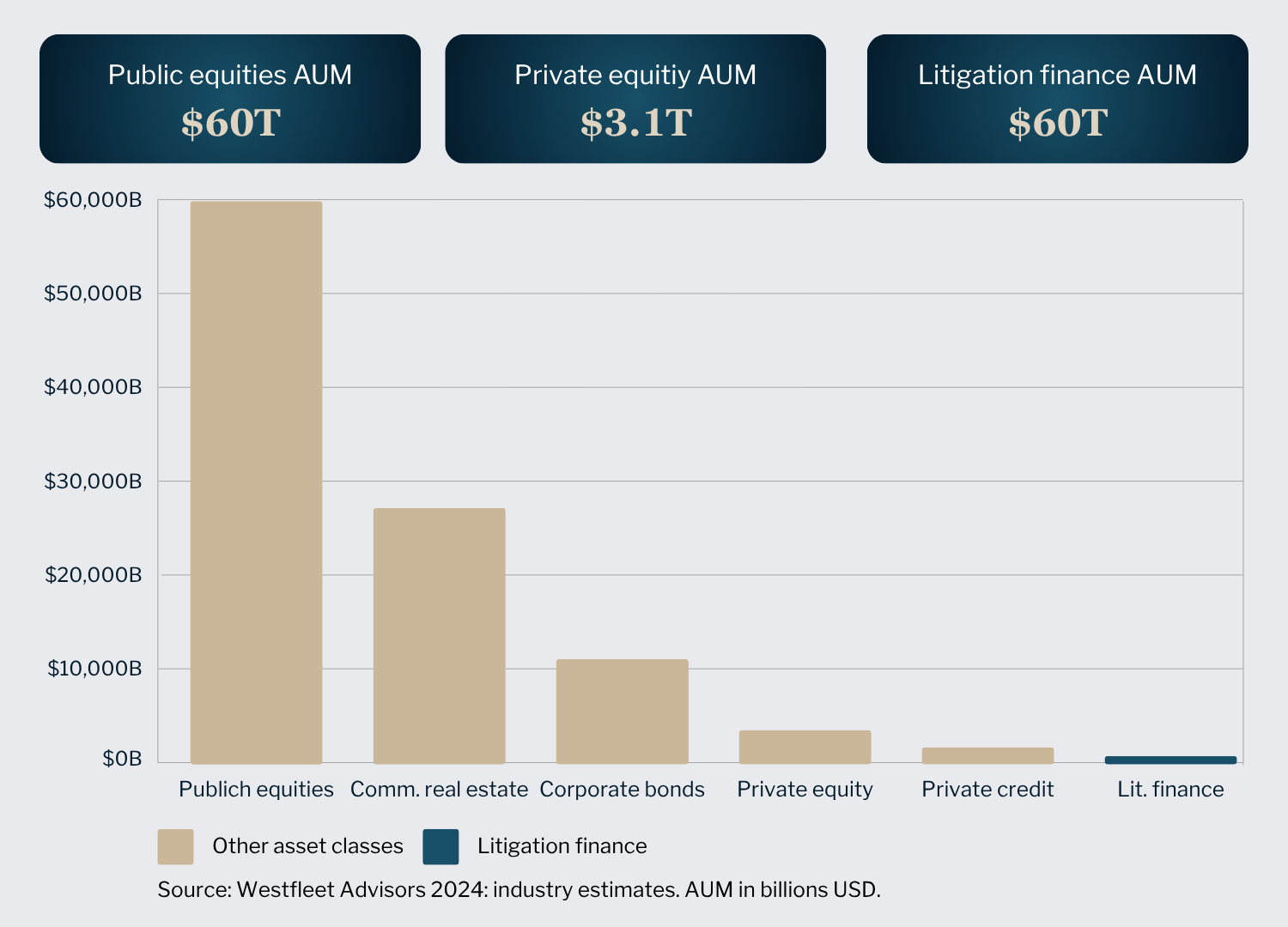
Commercial litigation finance is roughly 100 times smaller than private credit and nearly 200 times smaller than private equity. Just $2.3 billion in new commitments were made across the entire U.S. market in 2024 — a figure that, as the National Law Review noted, is smaller on an annual basis than niche asset classes most people have never heard of.
.png)
The takeaway is not that litigation finance lacks importance. For small and mid-sized businesses pursuing meritorious claims against well-resourced defendants, it is essential. The takeaway is that capital in this space is genuinely scarce — and increasingly concentrated.
The number of active litigation funders has hovered between 39 and 44 over the past three years, stabilizing at 42 in 2024 according to Westfleet. But stability in headcount masks a significant structural shift in where capital is flowing.
Total new commitments are now nearly 30% below 2022 peaks. Over that same period, average deal sizes have grown substantially — single-case deals rose from $4.8 million in 2023 to $6.6 million in 2024, and portfolio deals jumped from $9.9 million to $16.5 million. The direction is unmistakable: larger funders are writing fewer, bigger checks.
.png)
Big Law's share of total capital commitments rose to 37% in 2024 — even as the absolute dollars flowing to those firms declined slightly. More of a shrinking pool is being captured by the largest firms and the largest cases. Westfleet described 2023 as a "significant shake-up" in the industry, with funders rationing capital and becoming increasingly selective as funders were concentrating upmarket because raising fresh capital had become substantially harder.
Litigation funders that couldn't compete for Big Law’s transactions, or simply chose not to, were left serving a middle market with fewer players and less capital available than at any point in recent memory.
Understanding the fragmentation in this market requires understanding not just who the funders are, but at what stage they deploy.
The overwhelming majority of institutional litigation finance capital — over 80% by most estimates — is committed at the pre-settlement stage. That means funders are underwriting two variables simultaneously: whether the case will resolve favorably and how long it will take. The minimum case value thresholds that define this segment--most institutional funders require $1 million or more in potential damages, many require significantly more--reflect the risk premium demanded for carrying that outcome uncertainty.
Post-settlement/judgment funding occupies a structurally different position. By the time a post-settlement/judgment funder engages, the legal outcome is no longer a material variable. The parties have reached agreement or a judgment has been won. What remains is time, for court approval, potential appeals, and claims administration. In a very true sense, the funder is underwriting duration, not outcome.
.png)
Despite offering a cleaner risk profile, post-settlement/judgment funding remains dramatically underrepresented in deployed capital relative to its actual risk characteristics. An NYU Law Review study found that post-settlement funding offers better risk-adjusted terms than pre-settlement alternatives — yet the market remains comparatively thin, largely because fewer funders specialize in it and it is less widely understood by the lawyers who could benefit from it most.
The fragmentation of the litigation finance market has direct practical consequences for how lawyers should approach the funding conversation.
Dominant players in litigation finance are formidable institutions with deep capital bases and well-established underwriting frameworks. They are also increasingly focused on large, complex, institutional legal transactions. If your matter falls below their thresholds in size or doesn't fit their case type criteria, the conversation will be short.
That does not mean capital is unavailable. It means you are talking to the wrong funder.
The gap in this market is not at the top. The gap is in settled matters, confirmed recoveries, and cases where the legal work is essentially complete but disbursement has not yet arrived. This is where more nimble specialized funders operate. And for lawyers with clients experiencing cash flow pressure between a settlement/judgment and the arrival of funds, understanding the structure of this market--where capital concentrates and where it simply does not pay have outreach--is the first step to finding the right funding partner for your practice.
RD Legal Funding has been providing post-settlement and post-judgment funding to plaintiffs, their counsel, and litigation professionals since 1998. To learn more, visit www.legalfunding.com or call (800) 565-5177.
Sources: Westfleet Advisors, 2024 Litigation Finance Market Report; National Law Review; NYU Law Review, "The Mysterious Market for Post-Settlement Litigant Finance"; Verisk; Insurance Journal; PR Newswire.
RD Legal Funding provides tailored capital solutions for law firms by accelerating access to post-settlement and earned fees. We understand that managing a successful legal practice requires more than just winning cases—it requires strategic financial planning and reliable capital partnerships.
To learn more about strategic options for your practice:
Phone: (800) 565-5177
Email: info@legalfunding.com
Website: www.legalfunding.com
Roni Dersovitz is the founder and CEO of RD Legal Funding, a pioneer in providing innovative liquidity solutions for contingency law firms, settlement claimants, and legal receivables. With over 25 years of experience in litigation finance, Roni has helped transform legal victories into immediate financial results for thousands of clients. To learn more, visit www.legalfunding.com or contact us at info@legalfunding.com or (800) 565-5177.


.png)
.png)