%201.svg)
%201.svg)


The Hidden Cost of Winning: What Hernia Mesh Mass Torts Teach Contingency Lawyers About Cash Flow
Date:
July 21, 2026
Author:
Roni Dersovitz, Esq.
.png)
An active plaintiff's firm can have hundreds of thousands or even millions of dollars locked up in case costs at any given time, capital that is not available for growing the practice or distributing to partners. Contingency fee firms often incur significant upfront costs for expert witnesses, court costs, and litigation expenses before receiving any payment, and even after a case resolves, it may take considerable additional time for awards to be distributed and fees to be collected.
When funds are scarce, firms may be forced to cut back on critical investments such as marketing, technology, or hiring top talent, limiting the firm's ability to generate new business and serve existing clients effectively. The opportunity cost of tying up large sums in case expenses can be immense.
That structural challenge is manageable when timelines hold. The Hernia Mesh mass torts case demonstrates what happens when they don't.
The Bard Hernia Mesh litigation is the clearest available illustration of how case duration assumptions diverge from reality — and what that divergence costs law firms.
Figure 1.0: Hernia Mesh Timelines
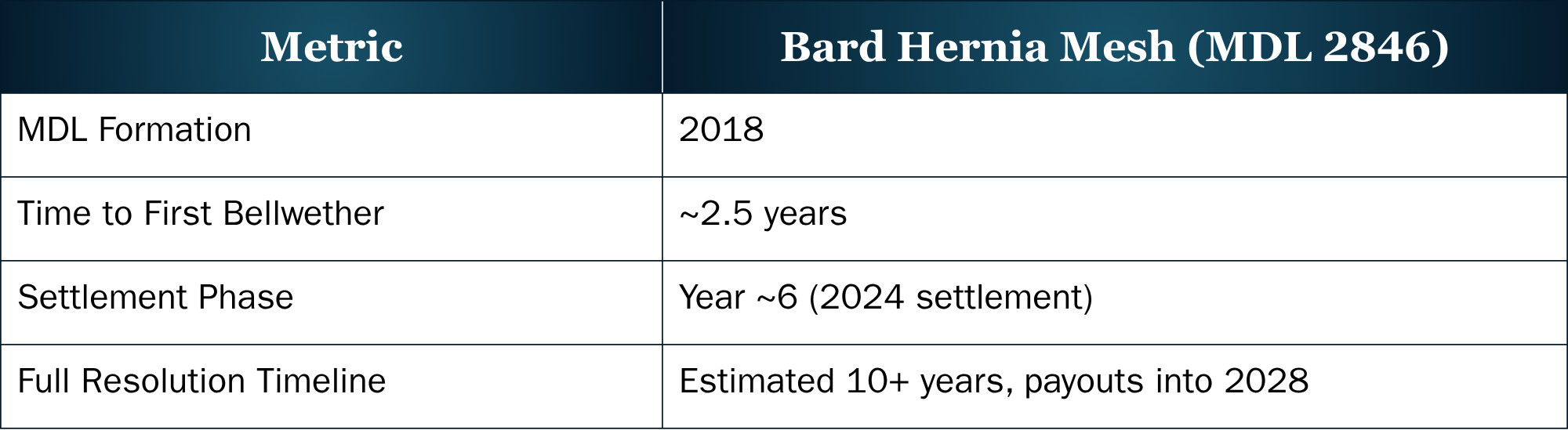
In October 2024, Becton Dickinson, the parent company of C.R. Bard, approved a settlement to resolve nearly 38,000 lawsuits spanning 20 years. Twenty years. A litigation portfolio that originated at the turn of the century is only now reaching resolution, and even that resolution is not delivering immediate payment.
Disbursements from the Bard settlement began in 2025 and will be paid over several years, with average settlement ranges of $60,000 to $100,000 per claimant depending on severity. For law firms that have been carrying these cases — funding expert witnesses, depositions, medical record reviews, and administrative costs for years — the wait is not over. For plaintiffs who opt out of the Bard settlement, mediations will not occur until January 2027, and trial dates may be delayed further still.
The lesson is that even winning litigation — at scale, with confirmed settlements — does not produce immediate liquidity for the firms that funded it.
Insurance carriers facing financial pressures of their own have responded with increasingly protracted negotiations, expanded motion practice, and reduced settlement offers — all aimed at extending the timeline to payment. For contingency firms, these tactics directly impact cash flow at precisely the time when operational stability is most crucial.
The financial consequences compound in predictable ways. Firms managing large mass tort portfolios have typically funded those campaigns through credit facilities extended against projected resolution timelines. When those timelines extend —sometimes by a decade or more as is seen with Hernia Mesh — those facilities come under pressure.
As interest rates have risen and lenders have grown more cautious, traditional credit options for law firms have contracted significantly. Lenders increasingly view contingency receivables as speculative despite strong historical performance data, creating a credit environment where even established firms with excellent case portfolios struggle to secure operational financing.
The result is a compounding problem: extended timelines strain credit facilities, restricted credit forces firms to make decisions driven by liquidity rather than legal strategy, and the cases that have been in litigation for years — the ones that should be generating the firm's biggest fees — become the source of its greatest financial pressure.
Many plaintiff firms must ration capital, turning away good cases because they need all their existing capital to adequately fund existing cases, let alone finance new ones, mass torts, or class actions. The firm's growth stalls not because of the quality of its legal work, but because of the timing of its collections.
Within every firm managing extended mass tort litigation, there is typically a meaningful portfolio of cases that have already resolved. Matters where agreements are signed, fees are earned, and the only remaining variable is the disbursement process.
These cases are structurally different from pending litigation. The legal risk is gone. The outcome is confirmed. What remains is a timing problem: court approval, settlement administration, lien resolution, medical record audits, plaintiff outreach, and the administrative mechanics of moving confirmed funds from a settlement account to a distribution check.
Forward-thinking firms are increasingly recognizing that uncertainty of timing does not diminish the underlying value of well-developed cases. What appears as a liquidity problem is actually an asset utilization opportunity. The substantial value locked in confirmed receivables represents a significant resource that, properly leveraged, can transform both operations and outcomes.
That is the specific opportunity that post-settlement/judgment funding addresses, and it is one that most conventional lenders are structurally unable to serve. Personal injury firms operating on contingency face entirely different cash flow patterns than corporate firms billing monthly, and most lenders have not built underwriting frameworks that recognize confirmed legal receivables as the assets they are.
Understanding the difference between these two funding stages is directly relevant to how law firms should think about their own financial options.
Pre-settlement/judgment funding — whether through a litigation funder advancing against pending cases or a credit facility secured against anticipated fee income — carries the full weight of two interdependent uncertainties: whether the case will resolve favorably and when the payments will be distributed. When both assumptions hold, the economics work. When either breaks, as Hernia Mesh and dozens of comparable mass torts have demonstrated, the consequences cascade.
Post-settlement/judgment funding operates on different mechanics entirely. By the time a post-settlement/judgment funder engages, the legal outcome has already been determined. The funder is underwriting time, not merit. For law firms, this means that confirmed settlements — even settlements still months or years from final distribution — represent a category of asset that can be monetized today, independently of what is happening with the firm's pending case portfolio or its existing credit facility.
The return to the firm is not theoretical future income. It is confirmed earned revenue, accessed earlier than the disbursement process would otherwise allow.
For law firms managing extended mass tort portfolios where credit facilities are under pressure from prolonged timelines, capital solutions designed to provide stable working capital through the final phase of the litigation lifecycle can provides a lifeline.
For individual settled matters creating cash flow pressure, seeking direct advances against confirmed fees, structured around the specific disbursement timeline of each matter, underwritten based on the confirmed recovery rather than on projected future case outcomes, can provide working capital needed sustainability.
The firms that have navigated extended litigation timelines most effectively are those that understood early that settled cases and pending cases are different financial instruments — and that the liquidity available from confirmed receivables does not have to wait for the administration process to complete.
RD Legal Funding provides tailored capital solutions for law firms by accelerating access to post-settlement/judgment and earned fees. We understand that managing a successful legal practice requires more than just winning cases; it requires strategic financial planning and reliable capital partnerships.
To learn more about strategic options for your practice:
Phone: (800) 565-5177
Email: info@legalfunding.com
Website: www.legalfunding.com
Roni Dersovitz is the founder and CEO of RD Legal Funding, a pioneer in providing innovative liquidity solutions for contingency law firms, settlement claimants, and legal receivables. With over 25 years of experience in litigation finance, Roni has helped transform legal victories into immediate financial results for thousands of clients. To learn more, visit www.legalfunding.com or contact us at info@legalfunding.com or (800) 565-5177.
Sources: Clio 2024 Legal Trends Report; Westfleet Advisors 2024 Litigation Finance Market Report; Plaintiff Magazine, "Financial Management in a Contingent Fee Practice"; Esquire Bank Legal Industry Report 2024; MDL Statistics Report, United States Judicial Panel on Multidistrict Litigation (May 2026); Miller & Zois Hernia Mesh Litigation Updates; LawFirm.com Hernia Mesh Lawsuit Timeline.


.png)
.png)